How long can the California Franchise Tax Board collect on back taxes?
The California Franchise Tax Board has up to 20 years to collect a state tax debt, twice the 10 years the IRS gets from the date it assesses a federal tax. California's clock is set by Revenue and Taxation Code section 19255 and starts when the latest liability for that tax year becomes "due and payable," not when you filed. Because the statute counts fees as tax liability, a collection fee or lien fee added years later can restart the 20-year period from that newer date, extending how long the FTB can pursue the balance. The clock is also paused during bankruptcy, an active installment agreement, service in a combat zone, or a federally declared disaster. The IRS and the FTB are separate agencies collecting separate debts, so a federal balance and a California balance run on two different timelines.
Watch Carlos explain the 20-year California FTB collection rule
Ray owed California back taxes.
He decided to wait it out.
Here's why. California has a rule. The state gets 20 years to collect a tax debt. After 20 years, the debt dies. Gone. Ray knew about the rule. So he waited.
He waited 18 years.
He kept a spreadsheet in a drawer he did not like to open. Every year, he did the same math. Two more years. Then freedom.
But something happened in year 11 that Ray never noticed.
The state filed a lien against him. A lien is a legal claim on everything you own. A computer filed it automatically. And the state added a fee to his account. A few hundred dollars. Ray never opened the notice. Into the drawer it went.
That fee changed everything.
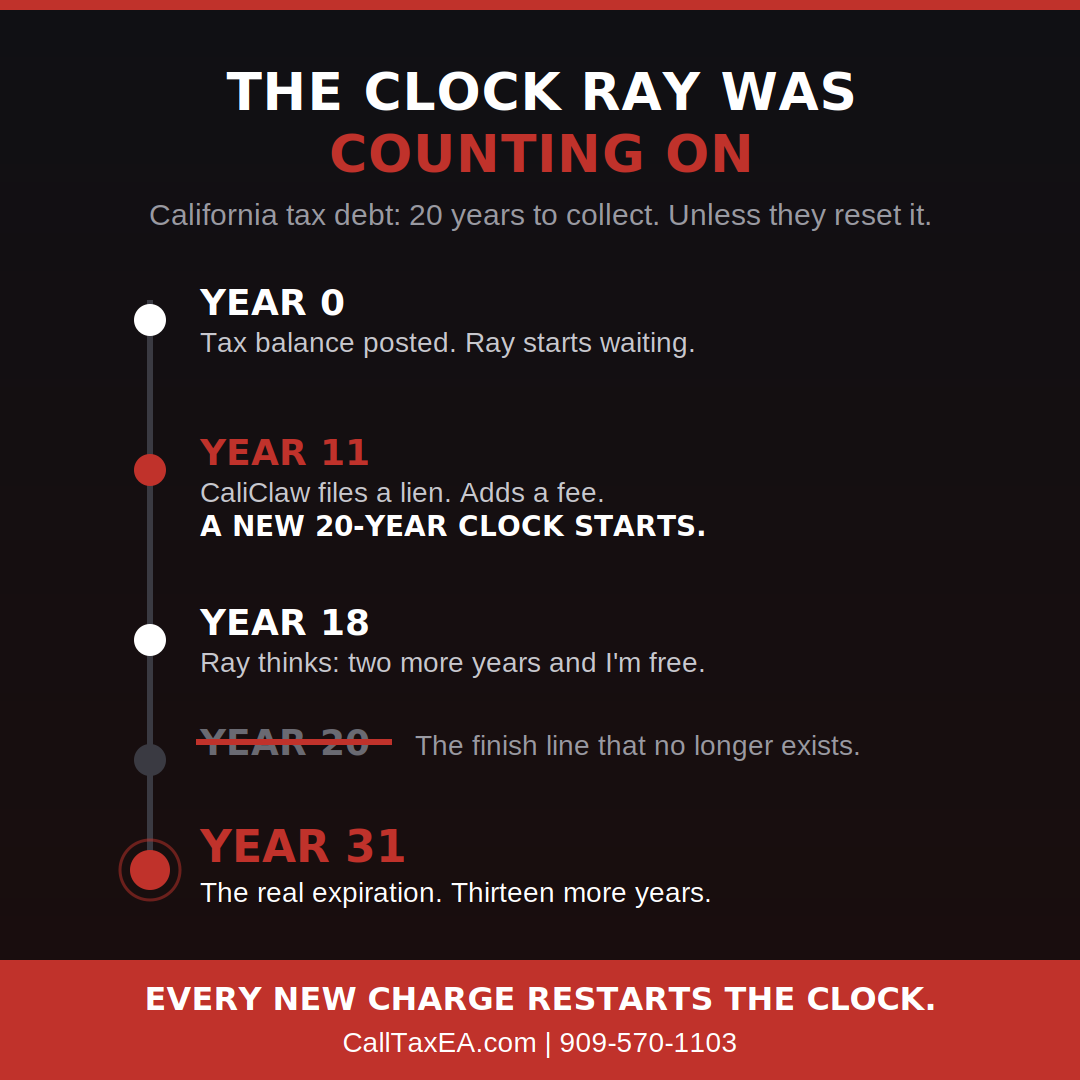
Because here's the rule nobody tells you: every time California adds a new charge to your account, the 20-year clock starts over. From zero.
New charge in year 11. New clock. That clock runs until year 31.
So when Ray sat at his kitchen table in year 18, thinking he had two years left, the truth was worse.
He had thirteen.
Seven years of waiting. Wasted. And every one of those years, penalties and interest kept piling on.
This is why I call the Franchise Tax Board CaliClaw. The IRS gets ten years, then lets go. CaliClaw gets twenty. And CaliClaw holds the reset button. A lien fee. A collection fee. A new assessment. Any one of them starts the clock over.
Waiting is not a plan. In California, time is on their side, not yours.
See the chart below. That's Ray's clock. Look at where he thought the finish line was. Then look at where it really is.
If you have a California balance and you have been waiting for it to disappear, stop counting and start checking. The only way to know your real expiration date is to pull the account and read what CaliClaw has actually done to it. Fees. Liens. Resets. It is all on the transcript, and it rarely says what you hope it says.
Call 909-570-1103. Or go to CallTaxEA.com and tell me what year you are dealing with.
If you are not ready to talk, start at CaliClaw.com and learn how the California clock really works before it costs you another decade.
I have read these transcripts for people who thought they were two years out and were not. I will read yours.
To your survival.
More California FTB questions
CaliClaw moves differently than the IRS. See the other FTB questions I answer in the office.
Browse the FTB FAQ hub →